To scale a home recipe for production, get every ingredient into grams, express the recipe as ratios, and scale to the batch weight you actually need. Then make a test batch at the new size, because some things change with batch size even when the ratios stay put: leavening behavior, how seasoning reads, bake time, mixing heat and evaporation. Write down what you changed. The version you produce is the version your label has to describe.
Get everything into grams first
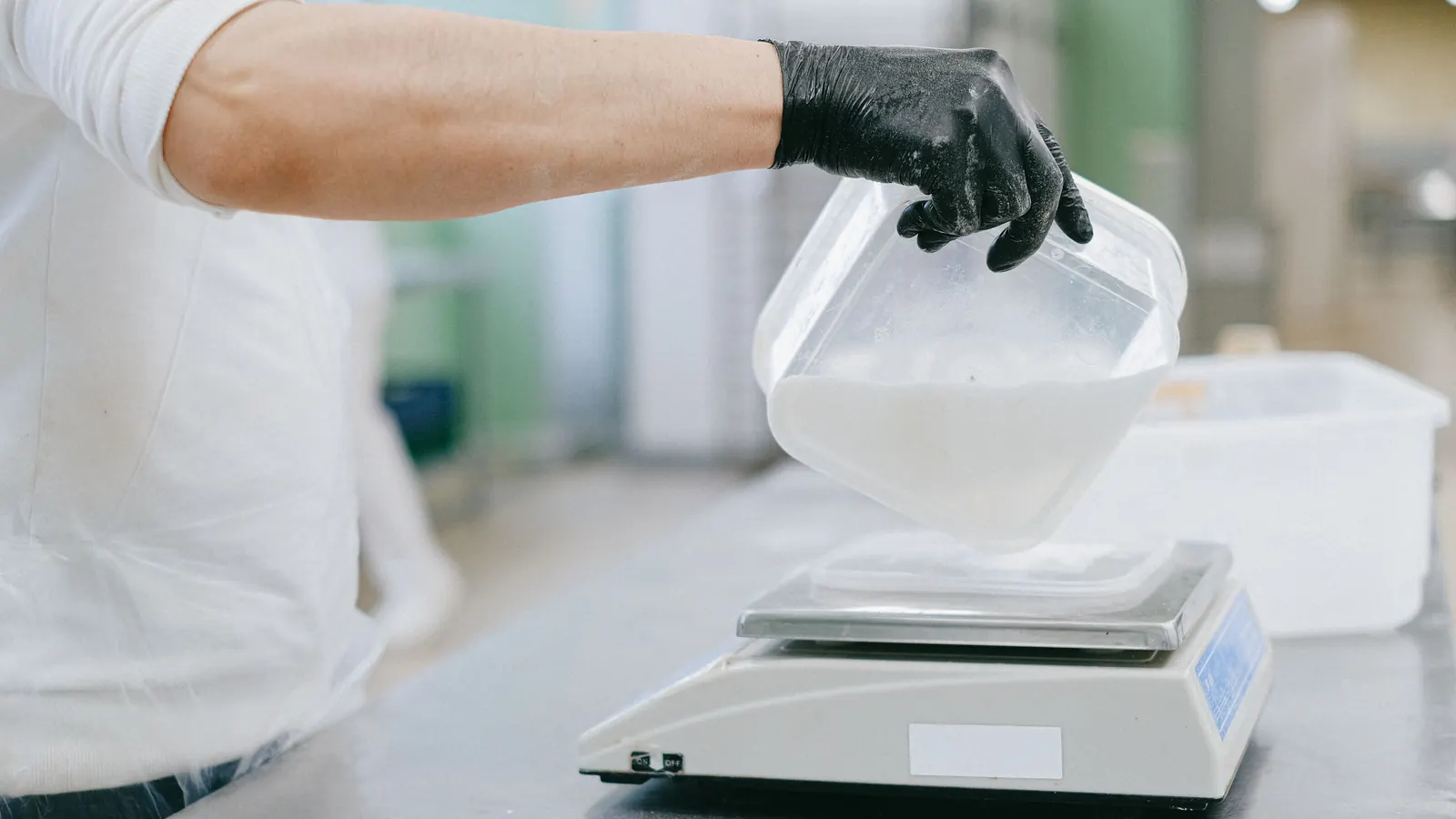
Cups and spoons scale badly. A cup of flour weighs different amounts depending on how it was scooped, and that error multiplies with the batch. Weigh each ingredient the way you actually measure it at home, write the grams down, and work from those. If you need a starting point for volume-to-weight conversions, cups to grams and volume measurements covers where those numbers come from and how far to trust them.
Once everything is in grams, scaling is multiplication, and a weighing error stays the same size relative to the batch instead of compounding.
Baker's percentages
In baker's percentage, each ingredient is expressed as a percentage of the flour weight, and flour is always 100% (King Arthur Baking). Water at 70% means 70 g of water for every 100 g of flour, whatever the batch size. The percentages add up to more than 100, and that total is what lets you scale to a target weight.
Here is an example lean bread dough. The home batch is a plausible single-loaf recipe; the production run is 60 loaves at 800 g of dough each, so 48,000 g.
| Ingredient | Home batch (g) | Baker's % | Production, 48 kg (g) |
|---|---|---|---|
| Bread flour | 500 | 100% | 27,746 |
| Water | 350 | 70% | 19,422 |
| Salt | 10 | 2% | 555 |
| Instant yeast | 5 | 1% | 277 |
| Total | 865 | 173% | 48,000 |
The arithmetic follows King Arthur's method: divide the target dough weight by the total percentage to get the flour weight, then multiply each percentage by that flour weight.
- Total of the percentages: 100 + 70 + 2 + 1 = 173%, or 1.73.
- Flour: 48,000 ÷ 1.73 = 27,745.66 g, rounded to 27,746 g.
- Water: 27,745.66 × 0.70 = 19,421.97 g, rounded to 19,422 g.
- Salt: 27,745.66 × 0.02 = 554.91 g, rounded to 555 g.
- Yeast: 27,745.66 × 0.01 = 277.46 g, rounded to 277 g.
Some dough stays on the bowl, the hook and the bench. Weigh what you actually divide out of a test batch, and if it comes up short of the target, raise the target weight by the difference before you calculate.
Baker's percentages are built for flour-based doughs. For granola, sauces or anything without flour as the backbone, the same idea works with % of total batch weight: oats 45%, honey 15%, and so on. Once the recipe is written as ratios, any batch size is one division away.
Scaling by multiplier vs. by target yield
A multiplier says "make this 4 times." A target yield says "I need 48 kg of dough." For production, the target yield is usually the right question, because you're filling an order, a pan count or a mixer bowl.
The two give different answers. For the dough above, the true factor is 48,000 ÷ 865 = 55.49. A whole-number multiplier gets you 55× (47,575 g, about 59.5 loaves) or 56× (48,440 g, with dough left over). The target-yield method lands on the number you need.
Whichever way you scale, round at the end, and round things like yeast, salt and spices to a precision your scale can actually read.
What doesn't scale in a straight line
Scaling keeps the ratios the same, but heat, time and evaporation behave differently in a bigger batch. Plan to check each of the following in your first production-size test.
Leavening
Scale yeast and chemical leaveners straight for the first test batch, then watch the rise and the timing closely. Dough temperature is one reason a big batch can behave differently: King Arthur Baking's dough temperature reference explains that yeast grows best around 95°F and that controlling dough temperature is what keeps fermentation consistent, and the amount of dough in the mixer changes how much heat mixing adds (see mixing heat, below). If the dough rises faster than your schedule allows, you can reduce the yeast, shorten the proof, or cool the mix. Your test batch sets the amount.
Mixing heat
Mixing warms dough through friction. King Arthur Baking notes that the type of mixer, duration and speed of mixing, and the quantity of dough in the bowl all change how much heat the mix adds. The same dough temperature reference puts wheat doughs at 75 to 78°F at the end of the mix. Your home mixer's friction factor won't match a bigger machine or a bigger batch, so take the dough temperature after your first production mix and adjust your water temperature from there.
Salt and seasoning
Grams per kilogram don't change when you scale correctly, so a properly mixed dough at 2% salt is still 2% salt. In cooked foods, the concentration can drift anyway: a sauce that reduces more or less than it did at home ends up saltier or blander (see evaporation, below). Scale salt straight, taste the test batch at its finished weight, and adjust from there.
Herbs and spices, especially hot ones, need more caution. The Institute of Child Nutrition, a USDA-funded training center for school food service, teaches cooks in its lesson Adjusting a Recipe with Herbs and Spices to adjust them separately from the rest of the recipe and test the result, and warns that heat builds quickly with seasonings such as cayenne, mustard, cloves and peppercorns. In your first scaled test, hold the hot spices back below the full scaling factor, taste, and add more until it matches the original.
Bake time
Bake time depends mostly on the shape of what's in the oven. America's Test Kitchen names the depth and surface area of the dough or batter as the most important factors in setting bake time and temperature. If you scale a recipe by making more loaves of the same size, bake time barely moves, though a fuller oven can behave differently. If you scale by pouring the batter deeper or into a bigger pan, it changes. King Arthur's guide to baking pan size notes that more batter in a smaller pan can take 10 to 15 minutes longer, and a larger, shallower pan often bakes faster.
Evaporation in sauces, jams and syrups
Evaporation happens at the surface. When a Cook's Illustrated editor talks about doubling a batch of beans in the same pot, the point is that you have twice as much liquid but the same surface area, so reducing it takes longer. A sauce that reduced in 20 minutes in a home pot can take far longer in a deep kettle, and if you cook to a time instead of a target, you'll end up with a thinner, lower-yield or differently seasoned product. Cook to a measured end point (final weight, temperature or consistency) and record it.
That end point matters for the label too. If a reduction loses water, your finished weight is lower than the weight of the raw ingredients, and nutrition per serving changes. Nutrition labels and cooking moisture loss walks through how to account for it.
Equipment limits
Your mixer, kettle and oven set the real batch size. The 48 kg dough above is far more than most small-bakery mixers hold, so in practice it becomes several mixes. Four mixes of 12 kg, each a quarter of the production column, is the same formula.
Check the manufacturer's capacity chart for your mixer and read the notes. Hobart's chart for its Legacy+ mixers, for example, states that capacity depends on the moisture content of the dough, calls for reducing batch size by 10% with high-gluten flour, and another 10% when ice is used. A stiff, low-hydration dough can overload a mixer that handles a wetter dough of the same weight.
Ovens have their own limits: rack count, hot spots, and how much the temperature drops when you load a full deck. Pans and kettles set the surface area discussed above.
Run test batches at production size
A half-size test tells you less than you'd hope, because the effects above depend on size. Make at least one batch at the size you'll actually run, with the equipment you'll actually use, before you take an order that depends on it.
For each test, record:
- the formula in grams, including anything you changed from straight scaling
- water temperature, dough or batter temperature after mixing, and mix times at each speed
- fermentation and proof times, or cook time and end point for sauces
- pan size, fill weight, oven temperature and bake time
- finished weight of the batch and of a sample unit
- what you'd change next time
Document the production version
The production recipe is a different recipe from the one you started with. It might use 0.9% yeast instead of 1%, a different salt, or a longer reduction. Keep it as its own record with its own name. Managing recipe versions covers a naming and change-log habit that holds up when you reformulate later.
KitchenSync is nutrition label and recipe costing software for small food businesses. Its Create New Version button copies a recipe into a linked version, so the production formula and the home original sit side by side. Enter the production amounts in the new version, then enter the production batch's finished weight as its Output Weight so the label and cost per gram match the batch. Bakeries taking on wholesale orders will find more on KitchenSync for bakeries.
The label must match the production formula
Your Nutrition Facts panel and ingredient list describe what's in the package, so they have to be calculated from the production formula. These federal rules apply:
- Ingredients are listed in descending order of predominance by weight under 21 CFR 101.4(a)(1). If production changes the proportions enough to swap two ingredients' order, the ingredient list changes.
- Under 21 CFR 101.9(g), FDA judges a label by testing the product. A food is misbranded if calories, sugars, total fat, saturated fat, trans fat, cholesterol or sodium come in more than 20% above the declared value (101.9(g)(5)), or if naturally occurring protein, fiber, vitamins and minerals come in below 80% of it (101.9(g)(4)(ii)).
So if you raise the salt in production, recalculate. If you're not sure whether your product needs a Nutrition Facts panel at all, start with do I need a nutrition label. If you're calculating one from ingredient data rather than lab testing, making a Nutrition Facts label without a lab and choosing USDA FoodData Central entries cover how to do that carefully. This is general information about federal labeling rules, not legal advice; your state agriculture or health department can tell you what applies to your product.
Sources
- Baker's Percentage, King Arthur Baking
- Dough Temperature, King Arthur Baking
- Determining the friction factor in baking, King Arthur Baking, Barb Alpern, 2018
- Baking pan size, King Arthur Baking, Bronwen Wyatt, 2025
- No, You Can't Always Just Double a Recipe, America's Test Kitchen, 2024
- Adjusting a Recipe with Herbs and Spices, Institute of Child Nutrition (secondary source: USDA-funded training material)
- Legacy+ Mixers Capacity Chart, All Models (Metric), F40180, Hobart
- 21 CFR 101.4, Food; designation of ingredients, eCFR
- 21 CFR 101.9, Nutrition labeling of food, eCFR