Weigh your ingredients in grams, and convert any recipe written in cups using weights you measure yourself rather than a chart. Nutrition databases list nutrients per 100 grams and suppliers sell by the pound or kilogram, so every cup in a recipe has to become grams before you can work out a label or a cost. How many grams depends on how densely the cup was filled. A cup of flour can weigh anywhere from 120 g to 160 g, and that spread goes straight into your calories and your cost per batch.
Where to go next depends on what you need:
- If you want the numbers for flour, see how much a cup of flour weighs.
- If you're converting a recipe with other ingredients, see what a cup of each one weighs.
- If you're wondering about the 240 mL cup on Nutrition Facts labels, it's for labels, not recipes.
- If you're ready to move a recipe to grams, here is how to switch.
- If you measure milk, water or oil by volume, check when volume is close enough.
How much does a cup of flour weigh?
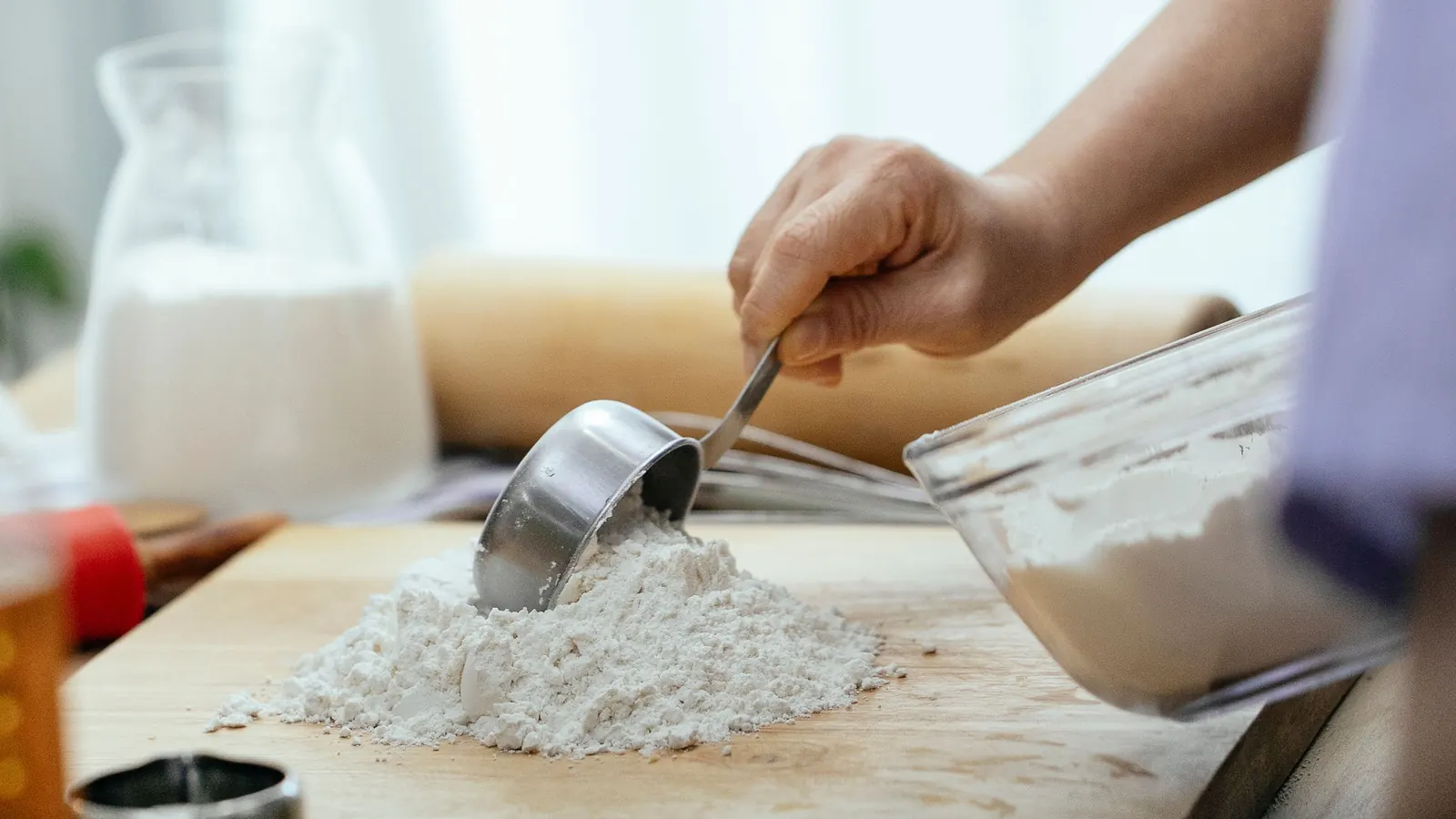
It depends on who fills it. King Arthur Baking's recipes assume 120 g per cup of all-purpose flour, measured by fluffing the flour, spooning it into the cup and leveling it. Their guide to measuring flour says a cup of more compacted flour "can hold up to 160 grams." USDA's SR Legacy entry for enriched all-purpose flour gives a cup as 125 g.
That's a spread of a third, for the same cup and the same flour.
Brown sugar shows it inside a single USDA entry. Sugars, brown lists one cup packed at 220 g and one cup unpacked at 145 g. Same cup, 52% more sugar.
Here is what that does to a recipe calling for 4 cups of flour, using the SR Legacy value of 364 kcal per 100 g:
| How the cup was filled | Flour weight | Calories from flour |
|---|---|---|
| Spooned and leveled (King Arthur) | 480 g | 1,747 |
| USDA portion weight | 500 g | 1,820 |
| Compacted (King Arthur's upper figure) | 640 g | 2,330 |
If your recipe is written in cups and the conversion assumes 120 g, while the person mixing scoops at 150 g, the dough gets 25% more flour than your label accounts for.
What does a cup of other ingredients weigh?
It depends on the ingredient. A cup of honey weighs four times as much as a cup of rolled oats. The table below uses USDA SR Legacy portion weights for one cup, fetched from FoodData Central. Density relative to water is the cup weight divided by 236.59 mL, the volume of a U.S. cup (NIST).
| Ingredient (FDC entry) | Grams per cup | Density vs. water |
|---|---|---|
| Oats, regular and quick, dry (173904) | 81 | 0.34 |
| Wheat flour, all-purpose, enriched, bleached (168894) | 125 | 0.53 |
| Sugars, brown, unpacked (168833) | 145 | 0.61 |
| Sugars, granulated (169655) | 200 | 0.85 |
| Oil, canola (172336) | 218 | 0.92 |
| Sugars, brown, packed (168833) | 220 | 0.93 |
| Butter, salted (173410) | 227 | 0.96 |
| Milk, whole, 3.25% (171265) | 244 | 1.03 |
| Honey (169640) | 339 | 1.43 |
Published tables don't always agree, either. King Arthur's chart lists a cup of vegetable oil at 198 g and granulated sugar at 198 g. USDA has canola oil at 218 g and granulated sugar at 200 g. The sugar figures are close; the oil figures are 10% apart. Neither source is wrong. They measured different products in different ways, and a volume recipe inherits whichever figure you happen to pick.
Cost suffers the same way. Say honey costs you $6.00 a pound (an example price), which is about 1.32 cents a gram. A batch of honey-glazed baklava, or a honey barbecue sauce, that calls for 2 cups of honey uses 678 g by the USDA weight, or $8.97 of honey. If your costing converts that cup as if it were water, it counts 473 g and $6.26. You'd be underpricing every batch by $2.71 before labor or packaging. The post on pricing baked goods goes through the rest of that calculation.
FDA's 240 mL cup is for labels, not recipes
FDA's nutrition labeling rule defines a teaspoon as 5 mL, a tablespoon as 15 mL, a cup as 240 mL and a fluid ounce as 30 mL. Those definitions govern the household measure printed next to a serving size, as in "2/3 cup (55 g)". They aren't meant for converting your recipe. By NIST's conversion factors, a U.S. measuring cup holds 236.59 mL, a tablespoon 14.79 mL and a teaspoon 4.93 mL. The serving size you declare should come from weighing your finished product anyway.
How do you switch a recipe from cups to grams?
Weigh in production. Weighing removes the person holding the cup from the calculation. It changes four things:
- Nutrition and cost calculations use the amount that actually went in.
- Two people on two shifts make the same product.
- Scaling is exact. Multiplying 480 g by 3 gives 1,440 g. Multiplying "4 cups" by 3 gives 12 cups and twelve chances to pack differently.
- It's usually faster. Put one bowl on the scale and tare between ingredients, and there are no cups to wash.
Use a scale that reads in 1 g steps for main ingredients. Salt, leaveners and spices are small enough that 1 g matters, and salt and baking soda drive the sodium line on your label, so weigh those on a scale that reads to 0.1 g.
To convert an existing recipe, don't look the cup up in a chart. Have whoever normally makes the recipe measure each volume ingredient the way they always do, onto a tared scale, three to five times. Average the results and rewrite the recipe in grams. The post on scaling a recipe to production covers the rest of the move from home batches to production batches.
When is measuring by volume close enough?
Volume works for water-thin liquids. Water is 1 g per mL, and milk is close at 1.03 by USDA's figure, so measuring milk by volume and converting at water's density is about 3% off. A graduated jug or a metered water dispenser is fine for those.
It stops working quickly once you move away from water:
- Oil is lighter than water. A cup counted as water's weight overstates canola oil by about 8.5%.
- Syrups and honey are heavier. Counting a cup of honey as water's weight understates it by about 30%.
- Anything that packs, settles or traps air doesn't qualify: flour, sugars, cocoa, oats, nuts, shredded coconut, grated cheese.
For anything you still measure by volume, use your own grams per cup rather than a chart: weigh how your team actually fills the cup and divide by 236.6 mL. Scooped flour at 140 g a cup is a density of 0.59. KitchenSync is nutrition label and recipe costing software for small food businesses. It converts volume amounts to grams with each ingredient's USDA density, or with a density you enter from your own weighing. Cottage bakers moving a family recipe from cups to grams can read more on KitchenSync for cottage food producers.
This is general information about federal labeling rules, not legal advice. Your product and your state's rules can change the answer, so check with your state agriculture or health department if you're unsure. The post on making a Nutrition Facts label without a lab covers the rest of the label math.
Sources
- Ingredient Weight Chart, King Arthur Baking (secondary source: manufacturer test kitchen)
- How to measure flour the right way, Rossi Anastopoulo, King Arthur Baking, October 13, 2023 (secondary source)
- 21 CFR 101.9, Nutrition labeling of food, Electronic Code of Federal Regulations (eCFR)
- NIST Guide to the SI, Appendix B.8: Factors for Units Listed Alphabetically, National Institute of Standards and Technology
- Wheat flour, white, all-purpose, enriched, bleached (FDC 168894), USDA FoodData Central, SR Legacy
- Sugars, brown (FDC 168833), USDA FoodData Central, SR Legacy
- Cereals, oats, regular and quick, not fortified, dry (FDC 173904), USDA FoodData Central, SR Legacy
- Sugars, granulated (FDC 169655), USDA FoodData Central, SR Legacy
- Oil, canola (FDC 172336), USDA FoodData Central, SR Legacy
- Butter, salted (FDC 173410), USDA FoodData Central, SR Legacy
- Milk, whole, 3.25% milkfat, with added vitamin D (FDC 171265), USDA FoodData Central, SR Legacy
- Honey (FDC 169640), USDA FoodData Central, SR Legacy