Pick the USDA FoodData Central (FDC) entry that describes the ingredient in the state it goes into your bowl, from the most specific source you can trust. For commodity ingredients such as flour, sugar, butter, oats and eggs, that usually means a Foundation or SR Legacy entry that matches your ingredient's description word for word, including "enriched", "salted" and "raw". For a branded ingredient, the product's own label or your supplier's spec sheet beats any database entry.
Where to go next depends on the ingredient:
- For flour, sugar, butter, oats and other plain ingredients, see which data type to use.
- If you picked a Foundation entry, check that it lists every nutrient you declare.
- If you're using a branded product's entry, check it against the package first.
- If the ingredient is enriched, salted or fortified, make sure the entry matches: see enriched flour, salted butter and fortified ingredients.
- If your supplier can send a spec sheet, see when it beats the database.
Which FoodData Central data type should you use?
For most ingredients, Foundation or SR Legacy. The table compares all four.
| Data type | How it's produced | Updates | Best use for a small producer |
|---|---|---|---|
| Foundation | Analytical values from individual food samples, with metadata on each sample | April and October each year | Commodity ingredients, where a matching entry exists and lists the nutrients you need |
| SR Legacy | The former USDA Standard Reference database: analyses, calculations and published literature | Final release April 2018; no further updates | Commodity ingredients with no Foundation match, and their cooked forms and portion weights |
| Survey (FNDDS) | Compiled from other FDC data, for foods reported in the What We Eat in America survey (NHANES) | Every two years, with the survey | Rarely. Occasionally a prepared component with no better match |
| Branded | Nutrition label information supplied by manufacturers | Monthly on the site; download files April and October | Checking a specific branded product, after comparing it with the package |
Table source: FoodData Central data documentation, USDA.
Foundation is USDA's current analytical work. Its documentation explains that it publishes individual sample results with details such as purchase location and date, so you can see variability rather than only an average. It started with 73 foods and is still narrower than SR Legacy.
SR Legacy is the older USDA Standard Reference database, and the Foundation documentation notes it supplied the values for most other public and private food composition databases. Being frozen, it misses later reformulations and new varieties, but it is broad and includes cooked forms and portion weights.
Survey (FNDDS) is the Food and Nutrient Database for Dietary Studies. The current version covers 2021 to 2023. Many of its entries are prepared foods and dishes as people report eating them, which is rarely what goes into a production recipe.
Branded comes from the Global Branded Food Products Database. The companies that supply the data are responsible for it, and USDA only converts their per-serving values to a per-100 g (or per-100 mL) basis.
Does the entry list every nutrient you declare?
Not always. Foundation entries list only what was analyzed. The Foundation entry for salted butter (790508) reports fat, water and sodium from 13 samples but no calories or protein. The SR Legacy entry for salted butter (173410) has a full set, including 717 kcal per 100 g. Before you use any entry, check that it has calories, protein, total fat, total carbohydrate and sodium, plus anything else you declare. If a Foundation entry is missing something you need, use the SR Legacy entry for the same food.
Which mistakes skew a label most?
Using a cooked entry for a raw ingredient
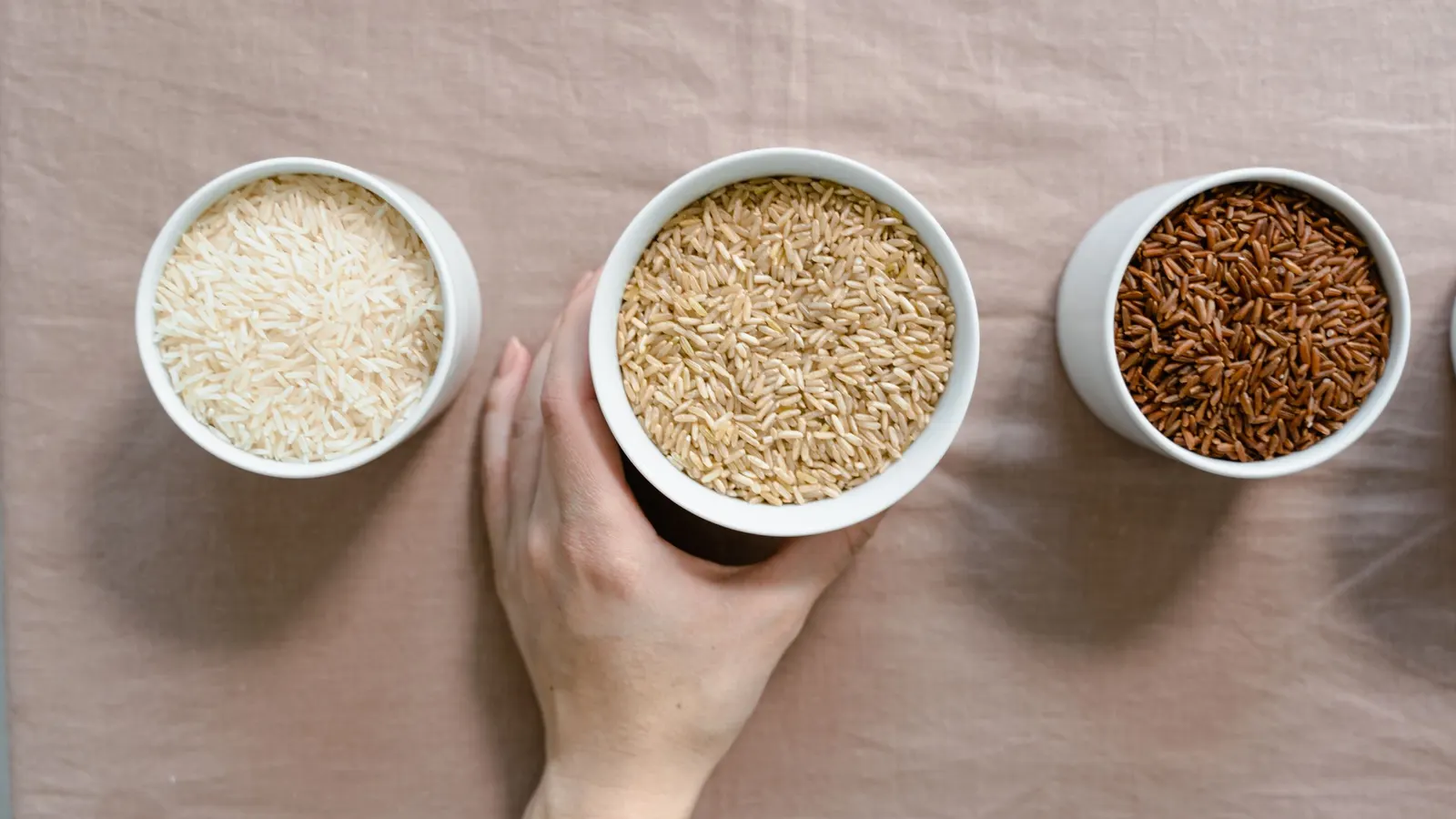
Raw and cooked entries for the same food often have nearly identical names and very different values: long-grain white rice is 365 kcal per 100 g raw and 130 kcal per 100 g cooked. Match the entry to the state the ingredient is in when you weigh it. The post on moisture loss and yield covers how to handle cooked components and cooking water.
Trusting a Branded entry without checking it
Branded values start as label values, and label values are rounded. FDA's nutrition labeling rule has total fat under 0.5 g per serving declared as zero. Take a product with a 14 g serving that declares 0 g fat. It could hold up to 0.49 g, which is up to 3.5 g per 100 g, but the per-100 g conversion turns the declared zero into zero. USDA's documentation warns that Branded values "may differ from those obtained through analytical measurements because of label rounding," and that a missing nutrient means the provider didn't supply it, not that the food has none.
Before you use a Branded entry:
- Confirm it's the exact product and formulation you buy, and compare it with the label on your package. Brands reformulate.
- Check that the calories roughly match 4 kcal per gram of protein and carbohydrate and 9 per gram of fat. A large mismatch points to a data entry error.
Mixing up enriched and unenriched flour
Enriched flour has thiamin, riboflavin, niacin, folic acid and iron added. The federal standard for enriched flour sets the levels: per pound, 20 mg of iron and 0.7 mg of folic acid, among others. The difference shows up clearly in the SR Legacy entries:
| Per 100 g | All-purpose, enriched, bleached (168894) | All-purpose, unenriched (169761) |
|---|---|---|
| Iron | 4.64 mg | 1.17 mg |
| Folate, DFE | 291 µg | 26 µg |
| Folic acid | 154 µg | 0 µg |
| Thiamin | 0.785 mg | 0.12 mg |
The enrichment standard's 0.7 mg of folic acid per pound works out to 154 µg per 100 g, which is exactly the SR Legacy figure.
Here's an example of what the wrong choice does to a label. A loaf uses 500 g of flour and weighs 800 g baked, so a 50 g slice contains 31.25 g of flour. With enriched flour, that's 1.45 mg of iron, 8% of the 18 mg Daily Value. With unenriched flour it's 0.37 mg, or 2%. Iron is a required line on every label, so check the bag.
The Foundation entry for enriched bleached all-purpose flour (789890) puts iron at 5.62 mg per 100 g. Enrichment varies by mill, so your mill's spec sheet is the better number.
Mixing up salted and unsalted butter
| Per 100 g | Butter, salted (173410) | Butter, without salt (173430) |
|---|---|---|
| Sodium | 643 mg | 11 mg |
Calories and fat are the same in both, 717 kcal and 81.1 g per 100 g. Take an example batch of 24 shortbread cookies made with 227 g of butter. Salted butter adds 1,460 mg of sodium to the batch, or 61 mg per cookie, which is declared as 60 mg. Unsalted butter adds 25 mg, about 1 mg per cookie, which is declared as 0 mg because sodium under 5 mg per serving rounds to zero.
Salted butter also varies by brand. The Foundation entry's 13 samples ranged from 412 to 643 mg of sodium per 100 g, with a mean of 524. In the cookie example that's anywhere from 39 to 61 mg per cookie. The sodium line on your butter's own label is the number to use.
Assuming a generic entry matches a fortified ingredient
Fortification levels differ by brand, and a generic entry may get them wrong or leave them out. FDC's descriptions say when an entry is fortified: Milk, whole, 3.25% milkfat, with added vitamin D (171265) lists 1.3 µg of vitamin D per 100 g, and the oats entry used in many granola recipes is labeled not fortified (173904). Match the description to your package, and for anything fortified, use the package label or spec sheet for the added nutrients.
If you add nutrients to your own product, FDA treats them as Class I nutrients, and a lab must find at least the amount you declare, not 80% of it.
When is your supplier's spec sheet better than USDA data?
Use the supplier's numbers when the ingredient is proprietary or varies by source:
- Branded or compound ingredients: chocolate and coatings, baking mixes, flavored syrups, spice blends.
- Ingredients where a generic entry hides real variation: butter sodium, flour enrichment, anything fortified.
- Anything from a new supplier.
Ask for nutrition per 100 g, the sub-ingredient list and the allergen statement. Keep a dated copy. FDA's guide to nutrition labeling databases leaves the source of label data up to the manufacturer and makes the manufacturer responsible for the result. The post on Big 9 allergens and sesame labeling covers the allergen side.
KitchenSync is nutrition label and recipe costing software for small food businesses, and its ingredient search follows the priority above: it covers Foundation and SR Legacy by default, with Survey (FNDDS) and Branded available as filters. If you bake, make granola or bottle a sauce and do your own labels, its nutrition label generator builds the Nutrition Facts panel from the entries you choose.
This is general information about federal labeling rules, not legal advice. Your product and your state's rules can change the answer, so check with your state agriculture or health department if you're unsure. For which products need a Nutrition Facts panel at all, see do I need a nutrition label, and for building one from database values, the post on Nutrition Facts labels without a lab.
Sources
- FoodData Central Data Documentation, USDA Agricultural Research Service
- Foundation Foods Documentation, USDA FoodData Central
- Global Branded Food Products Database (GBFPD) Documentation, USDA FoodData Central
- FNDDS Download Databases, USDA Agricultural Research Service, Food Surveys Research Group
- 21 CFR 101.9, Nutrition labeling of food, Electronic Code of Federal Regulations (eCFR)
- 21 CFR 137.165, Enriched flour, Electronic Code of Federal Regulations (eCFR)
- Guidance for Industry: Guide for Developing and Using Data Bases for Nutrition Labeling, U.S. Food and Drug Administration
- Butter, salted (FDC 173410) and Butter, without salt (FDC 173430), USDA FoodData Central, SR Legacy
- Butter, stick, salted (FDC 790508), USDA FoodData Central, Foundation
- Wheat flour, white, all-purpose, enriched, bleached (FDC 168894) and Wheat flour, white, all-purpose, unenriched (FDC 169761), USDA FoodData Central, SR Legacy
- Flour, wheat, all-purpose, enriched, bleached (FDC 789890), USDA FoodData Central, Foundation
- Rice, white, long-grain, regular, raw, unenriched (FDC 169756) and cooked without salt (FDC 169757), USDA FoodData Central, SR Legacy
- Milk, whole, 3.25% milkfat, with added vitamin D (FDC 171265), USDA FoodData Central, SR Legacy
- Cereals, oats, regular and quick, not fortified, dry (FDC 173904), USDA FoodData Central, SR Legacy