Divide your recipe's nutrient totals by the weight of the finished, cooled product, not by the weight of the ingredients that went in. Baking drives off water, but the calories, fat, protein and sodium stay behind, so every gram of the baked batch carries more of them. FDA's nutrition labeling rule has the label describe the food as it's packaged, which means the baked product. Divide by the raw weight and every number on the panel comes out too low, by the same share of weight the batch lost.
Where to go next depends on what you need:
- To see how far off a label gets, start with the bread example.
- If you don't have a finished weight yet, here is how to measure one.
- If a recipe uses cooked rice, pasta or beans, check which database entry you picked.
- If you declare vitamins or make a claim about one, read what heat destroys.
- If you changed the recipe, the pans or the batch size, weigh again.
How far off is a label divided by dough weight? A bread example
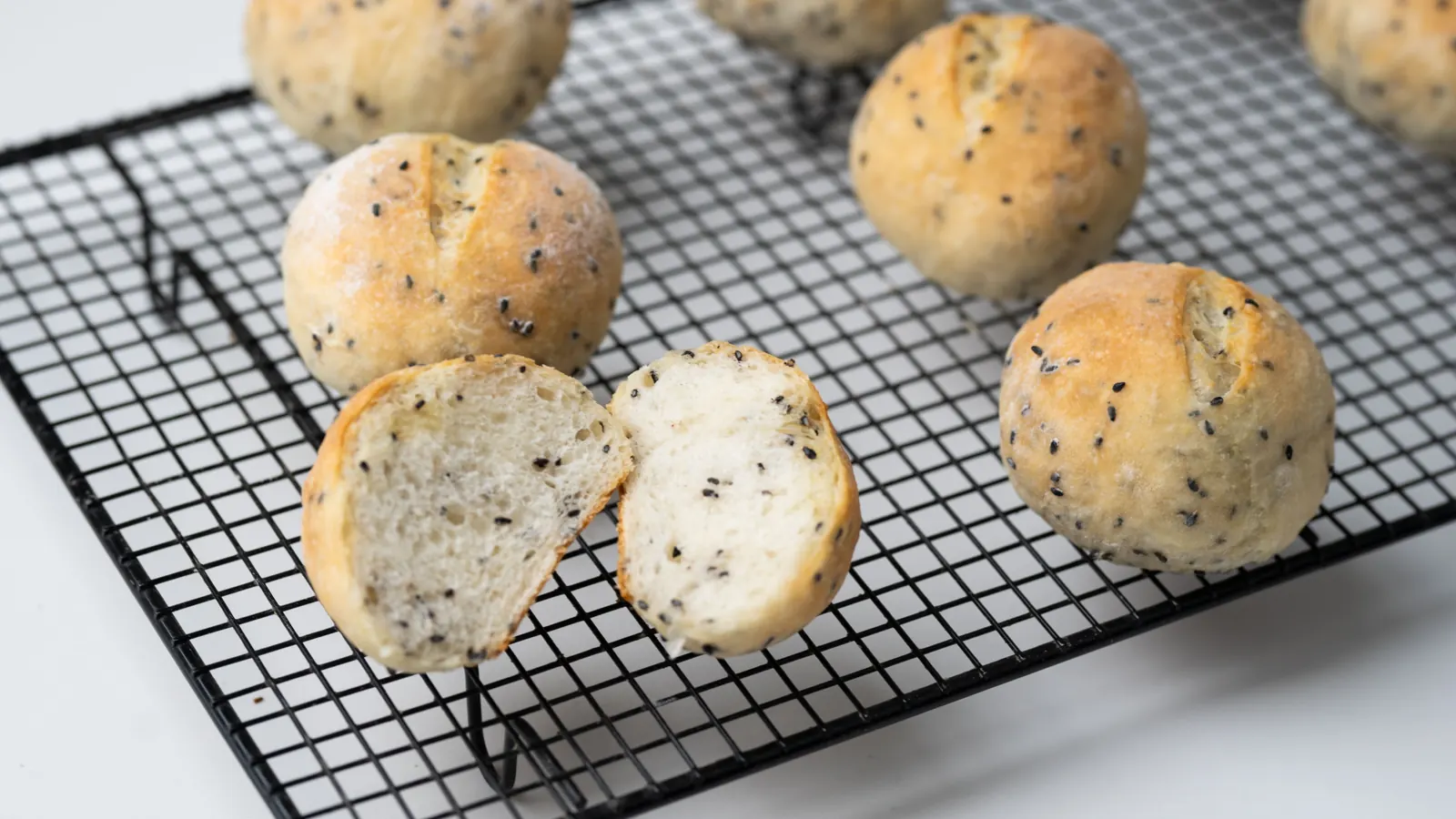
This is an example batch of plain white bread, made into two loaves: flour, water, yeast, salt and a little olive oil. The per-100 g values are the USDA SR Legacy entries (the final release of USDA's long-running Standard Reference database) for each ingredient, fetched from FoodData Central.
| Ingredient (FDC entry) | Amount | Calories in batch | Fat in batch | Sodium in batch | Water in batch |
|---|---|---|---|---|---|
| Wheat flour, white, all-purpose, enriched, bleached (168894) | 1,000 g | 3,640 | 9.80 g | 20 mg | 119.2 g |
| Water | 640 g | 0 | 0 g | 0 mg | 640.0 g |
| Oil, olive, salad or cooking (171413) | 40 g | 353.6 | 40.00 g | 0.8 mg | 0 g |
| Salt, table (173468) | 20 g | 0 | 0 g | 7,751.6 mg | 0.04 g |
| Leavening agents, yeast, baker's, active dry (175043) | 10 g | 32.5 | 0.76 g | 5.1 mg | 0.51 g |
| Total | 1,710 g | 4,026.1 | 50.56 g | 7,777.5 mg | 759.7 g |
You bake both loaves, let them cool completely and weigh them together: 1,420 g. The batch lost 290 g, which is 17% of the dough weight and about 38% of the water in it. That 17% belongs to this example batch. Your loss depends on your oven, pans, shaping and bake time, which is why the next section is about weighing your own batches.
Now work out a 50 g serving both ways.
- Using raw weight: 4,026.1 kcal × 50 ÷ 1,710 g = 117.7 kcal. Fat: 50.56 g × 50 ÷ 1,710 g = 1.48 g. Sodium: 7,777.5 mg × 50 ÷ 1,710 g = 227.4 mg.
- Using finished weight: 4,026.1 kcal × 50 ÷ 1,420 g = 141.8 kcal. Fat: 50.56 g × 50 ÷ 1,420 g = 1.78 g. Sodium: 7,777.5 mg × 50 ÷ 1,420 g = 273.9 mg.
The labeling rule rounds calories to the nearest 10 above 50, fat to the nearest half gram below 5 g, and sodium to the nearest 10 mg above 140 mg. The raw-weight label says 120 calories, 1.5 g fat and 230 mg sodium. The correct one says 140 calories, 2 g fat and 270 mg sodium.
FDA treats a food as misbranded when a lab finds calories, total fat, saturated fat, sodium, sugars and a few others more than 20% above the value printed on the label. Compare the true values with what the raw-weight label prints: 141.8 kcal is 18.1% above 120, 1.78 g of fat is 18.7% above 1.5 g, and 273.9 mg of sodium is 19.1% above 230 mg. That label passes only because all three numbers happened to round up, and it has almost nothing left over for the normal variation between batches. Had rounding gone the other way, it would fail. If the raw-weight calculation had come to 114 kcal per serving, the label would print 110, while the same 17% weight loss would put the true value at 137 kcal (114 × 1,710 ÷ 1,420), which is 25% over.
If you sell rolls by the piece and the serving is one roll, the nutrient numbers per roll are the batch total divided by the number of rolls, so they don't change with yield. The gram weight printed with the serving still does. Shape this same dough into 24 rolls and each one weighs 59 g baked (1,420 g ÷ 24), not the 71 g that the dough weight gives (1,710 g ÷ 24).
Products that start wetter than bread dough, such as roasted vegetables, reduced sauces and jerky, can lose a larger share of their weight, and the error grows with it.
How do you measure your yield?
The water your oven, pans and bake time remove is specific to your kitchen, so the only reliable number is one you weigh.
- Make the batch exactly as you do in production: same batch size, same pans, same oven load. A half batch on one tray loses water differently from a full oven.
- Scrape bowls and beaters well. Dough left on equipment is product, not water, but it shows up as lost weight. That makes every nutrient look more concentrated than it is. For calories, fat, sodium and sugars, overstating is the safe side of the 20% rule. For protein, fiber, vitamins and minerals it's the risky side, because a lab must find at least 80% of the declared amount of the nutrients that occur naturally in the food. If more than a spoonful stays behind, weigh it and reduce the recipe amounts by that share.
- Let the product cool to the point where you package it. Bread keeps losing steam as it cools, so a weight taken straight from the oven is too high.
- Weigh the whole baked batch, including edges you'll trim and pieces that break. Trim has the same composition as the rest of the batch, so leaving it out of the yield overstates every nutrient, with the same risk to protein, fiber, vitamins and minerals as in step 2. Trim is a costing loss: you paid for it and can't sell it. Account for it in your pricing, not in the nutrition yield.
- Repeat with at least three batches, weigh each one, and use the average. The batches can all be made the same day.
- Look at the spread. If one batch comes out at 1,380 g and another at 1,460 g, the process is the problem. Tighten bake time or oven loading before you put any number on a label.
Write the result down as grams of finished product per batch. That number is your yield. KitchenSync is nutrition label and recipe costing software for small food businesses, and each recipe in it has an Output Weight field for this number, which the label divides by. Bakers can enter their measured weight there and let the nutrition label generator build the panel from it.
Should you use the raw or the cooked database entry?
Either one, as long as the weight you enter matches it. USDA lists many ingredients both raw and cooked, and the numbers are far apart. Long-grain white rice, unenriched, is 365 kcal per 100 g raw (169756) and 130 kcal per 100 g cooked (169757). The cooked rice is about 68% water.
Enter the dry rice with the raw entry and add the cooking water as its own ingredient, or enter the cooked rice by its cooked weight with the cooked entry. With a measured finished weight, both give the same label.
Two mistakes cause trouble:
- Using the cooked entry with the dry weight. Enter 200 g of dry rice against the cooked entry and the recipe counts 260 kcal from rice instead of 730. Every nutrient from the rice is understated by almost two thirds.
- Using the cooked entry at cooked weight and also adding the cooking water as an ingredient. The cooked entry already contains that water. The extra water adds no nutrients, so a weighed finished batch still gives a correct label, but the raw weight and the moisture-loss figure are now wrong. If you estimate the yield from raw weight instead of weighing, the label is diluted.
The post on choosing FoodData Central entries covers other entry mismatches.
Does baking destroy nutrients as well as water?
Some, mainly vitamins. Moisture loss concentrates nutrients, and heat destroys part of a few of them. USDA publishes the USDA Table of Nutrient Retention Factors, Release 6 (December 2007), which gives retention factors for 16 vitamins, 8 minerals and alcohol across about 290 foods and cooking methods. It defines true retention as the share of a nutrient in the raw food that is still there after cooking, calculated from nutrient content and weight before and after cooking.
The table has rows for grain products. Baked flour and meal (code 0301), the row for bread, keeps 80% of thiamin, 70% of folate and 100% of the minerals listed. Toasted flour and meal (code 0306), the row for toasted grain products, keeps 80% of thiamin, 85% of folate and 100% of the minerals. The table has no factors for calories, fat, protein or carbohydrate.
Every label must declare vitamin D, calcium, iron and potassium. Both flour rows keep 100% of calcium, iron and potassium, so adjusting for moisture alone covers those three. The table has no factor for vitamin D, so it can't tell you how much survives baking. The bigger risk is a heat-sensitive vitamin you declare voluntarily or make a claim about, such as thiamin, folate or vitamin C. A lab must find at least 80% of the declared amount, and an unaccounted loss of 20% to 30% can put you under that line. In that case, apply the retention factors to those ingredients or get the finished product tested.
FDA's own guide to nutrition labeling databases describes ingredient databases as calculating label values "taking into account nutrient losses during processing," and it is clear that the manufacturer is responsible for the numbers on the label, whatever their source. The post on making a Nutrition Facts label without a lab covers when database values are enough and when to test.
When should you weigh the batch again?
Whenever the recipe or the process changes, because your yield depends on both:
- You change an ingredient, an amount or a supplier.
- You change bake time, temperature, pan size or oven.
- You scale the batch. A double batch in deeper pans can lose a different share of its water. The post on scaling a recipe to production goes through this.
- You see the finished weight drift. Weighing an occasional batch catches this early.
When a change is big enough to need a new label, keep the old recipe and its yield as a separate version rather than overwriting it, so you can still answer questions about product you've already sold. The post on managing recipe versions covers how.
This is general information about federal labeling rules, not legal advice. Your product and your state's rules can change the answer, so check with your state agriculture or health department if you're unsure.
Sources
- 21 CFR 101.9, Nutrition labeling of food, Electronic Code of Federal Regulations (eCFR)
- USDA Table of Nutrient Retention Factors, Release 6 (2007), USDA Agricultural Research Service, Nutrient Data Laboratory
- Guidance for Industry: Guide for Developing and Using Data Bases for Nutrition Labeling, U.S. Food and Drug Administration
- Wheat flour, white, all-purpose, enriched, bleached (FDC 168894), USDA FoodData Central, SR Legacy
- Oil, olive, salad or cooking (FDC 171413), USDA FoodData Central, SR Legacy
- Salt, table (FDC 173468), USDA FoodData Central, SR Legacy
- Leavening agents, yeast, baker's, active dry (FDC 175043), USDA FoodData Central, SR Legacy
- Rice, white, long-grain, regular, raw, unenriched (FDC 169756), USDA FoodData Central, SR Legacy
- Rice, white, long-grain, regular, unenriched, cooked without salt (FDC 169757), USDA FoodData Central, SR Legacy