You don't get to pick the serving size on a Nutrition Facts label. FDA sets a reference amount for each kind of food, based on how much people usually eat at once: 30 g for cookies, 1 teaspoon for hot sauce. Your serving is the everyday measure (a cup, a tablespoon, a piece) that comes closest to that amount, followed by its weight in grams. Then you divide your package by it to get servings per container.
How that works out depends on what you sell:
- Cookies, bars, muffins or anything else sold in pieces: the serving is a number of whole pieces, set by how much one piece weighs. Pieces and cookie examples
- Granola, cereal, flour or anything you scoop: the serving is the cup or spoon measure closest to the reference amount, and how much a cup weighs can decide which amount applies. Granola example
- Hot sauce, dressings, drinks and other pourable foods: the serving is a spoon or cup measure, shown in milliliters rather than grams. Hot sauce example
- A single cookie, bar or snack wrapped and sold on its own: the whole package may count as one serving, or need a second column on the label. Single-serving packages
Whatever you sell, the steps are the same: find your reference amount, turn it into a household measure, weigh that measure, and count the servings in the package.
Which reference amount applies to your product?
FDA's official name for the reference amount is the Reference Amount Customarily Consumed, or RACC, and you'll see that term on forms and in FDA guidance. The amounts are listed by food group in FDA's table of reference amounts, 21 CFR 101.12. These rows cover the three examples in this post and a few close neighbors:
| Product category | RACC | Label statement in the table |
|---|---|---|
| Cookies | 30 g | __ piece(s) (__ g) |
| Grain-based bars, e.g., breakfast bars, granola bars | 40 g | __ piece(s) (__ g) |
| Breakfast cereals, ready-to-eat, weighing 20 g or more but less than 43 g per cup | 40 g | __ cup(s) (__ g) |
| Breakfast cereals, ready-to-eat, weighing 43 g or more per cup; biscuit types | 60 g | __ piece(s) (__ g) for large distinct pieces (e.g., biscuit type); __ cup(s) (__ g) for all others |
| Major condiments, e.g., catsup, soy sauce, marinades | 1 tbsp | 1 tbsp (__ g); 1 tbsp (15 mL) |
| Minor condiments, e.g., horseradish, hot sauces, mustards, Worcestershire sauce | 1 tsp | 1 tsp (__ g); 1 tsp (5 mL) |
If your product isn't named, FDA's guidance Reference Amounts Customarily Consumed: List of Products for Each Product Category (February 2018) lists example products for each row. It places biscotti and rugelach under cookies, for instance, though the table itself doesn't name them. In borderline cases, the category follows what the food is mainly used for, and the amount counts only the part you eat, not pits, shells or bones.
Loose granola isn't named in the table or in FDA's list. Sold as a breakfast cereal, it falls in one of the ready-to-eat cereal rows, and which one depends on how much a cup of it weighs. A granola marketed as a snack could arguably fall under grain-based snack mixes (30 g) instead; what it's mainly used for decides. A granola bar is a grain-based bar at 40 g.
These serving rules came with FDA's 2016 update to the Nutrition Facts label. Manufacturers with less than $10 million in annual food sales had to comply by January 1, 2021.
How do you turn the reference amount into a cup, spoon or piece?
The serving on the label is written as a household measure: a cup, tablespoon, teaspoon, piece, slice, fraction, ounce or fluid ounce, or the container itself. FDA's nutrition labeling rule sets the order of preference:
- Use cups, tablespoons or teaspoons wherever they fit. Cups go in 1/4- or 1/3-cup steps. Tablespoons can be 1, 1 1/3, 1 1/2, 1 2/3, 2 or 3. Teaspoons can be 1/8, 1/4, 1/2, 3/4, 1 or 2.
- If those don't fit, use a piece, slice, jar, tray or fraction.
- Only if neither works, use ounces with a description of what that looks like, such as "1 oz (28 g/about 1/2 pickle)".
For products you scoop, like cereal or flour, the serving is the household measure that comes closest to the reference amount. If it falls exactly halfway between two allowed sizes, round up to the larger one. For labeling, a teaspoon is 5 mL, a tablespoon 15 mL, a cup 240 mL, a fluid ounce 30 mL and an ounce 28 g.
What if you sell cookies, bars or other pieces?
Products sold in pieces follow a separate rule, based on how much one piece weighs compared with the reference amount:
| One piece weighs | Serving size |
|---|---|
| 50% of the RACC or less | The number of whole pieces closest to the RACC |
| More than 50%, under 67% | One piece or two, your choice |
| 67% or more, under 200% | One piece |
| 200% to 300% inclusive | The amount closest to the RACC, plus a second column for the whole piece |
How do you find the weight of one serving?
After the household measure comes its metric amount in parentheses: milliliters for liquids, grams for everything else. Round to the nearest whole gram or milliliter. Between 2 and 5, round to the nearest 0.5, and under 2, use 0.1 steps. You can add ounces after a slash, as in "1 slice (28 g/1 oz)".
Weigh this number rather than looking it up. FDA's guidance on metric equivalents of household measures says that when FDA tests a label for accuracy, "assessment of compliance is based on these metric quantities." The guidance asks you to measure at least 10 times the reference amount to keep measuring error down, to take samples from several lots, and to repeat the measurement enough times that the average is representative. It also says how to fill the measure: flaky cereals go in gently, without sifting, stirring or packing, and pieces like nuts should rise above the fill line about as much as the air gaps below it.
How many servings are in your package?
Divide the net contents by the serving size, then:
- Round to the nearest whole number.
- Between 2 and 5 servings, round to the nearest 0.5 instead.
- When you round, say so with "about", as in "about 3.5 servings".
Products sold by random weight, such as cheese cut to order, can say "varied".
When is the whole package one serving?
Package size can override the steps above.
- A product packaged and sold on its own that holds less than 200% of the reference amount is a single-serving container, and the whole package is labeled as one serving. Between 150% and 200%, you may add an optional column for the household measure closest to the reference amount, to the left of the per-package column.
- A product packaged and sold on its own that holds 200% to 300% of the reference amount needs two columns: one per serving and one for the entire package. Packages small enough to use the small-package label formats are among the exceptions.
- A single piece inside a multi-serving package that weighs 200% to 300% of the reference amount gets the same treatment: a per-serving column and a per-piece column.
A single-serving container doesn't need the servings-per-container line, or the metric amount after the serving size, since the net quantity on the front already gives it. If you print the metric amount anyway, it has to match the net quantity exactly.
Example: cookies in five sizes
All weights here are examples. Weigh your own baked cookies, several from different batches, and use the average. The RACC is 30 g.
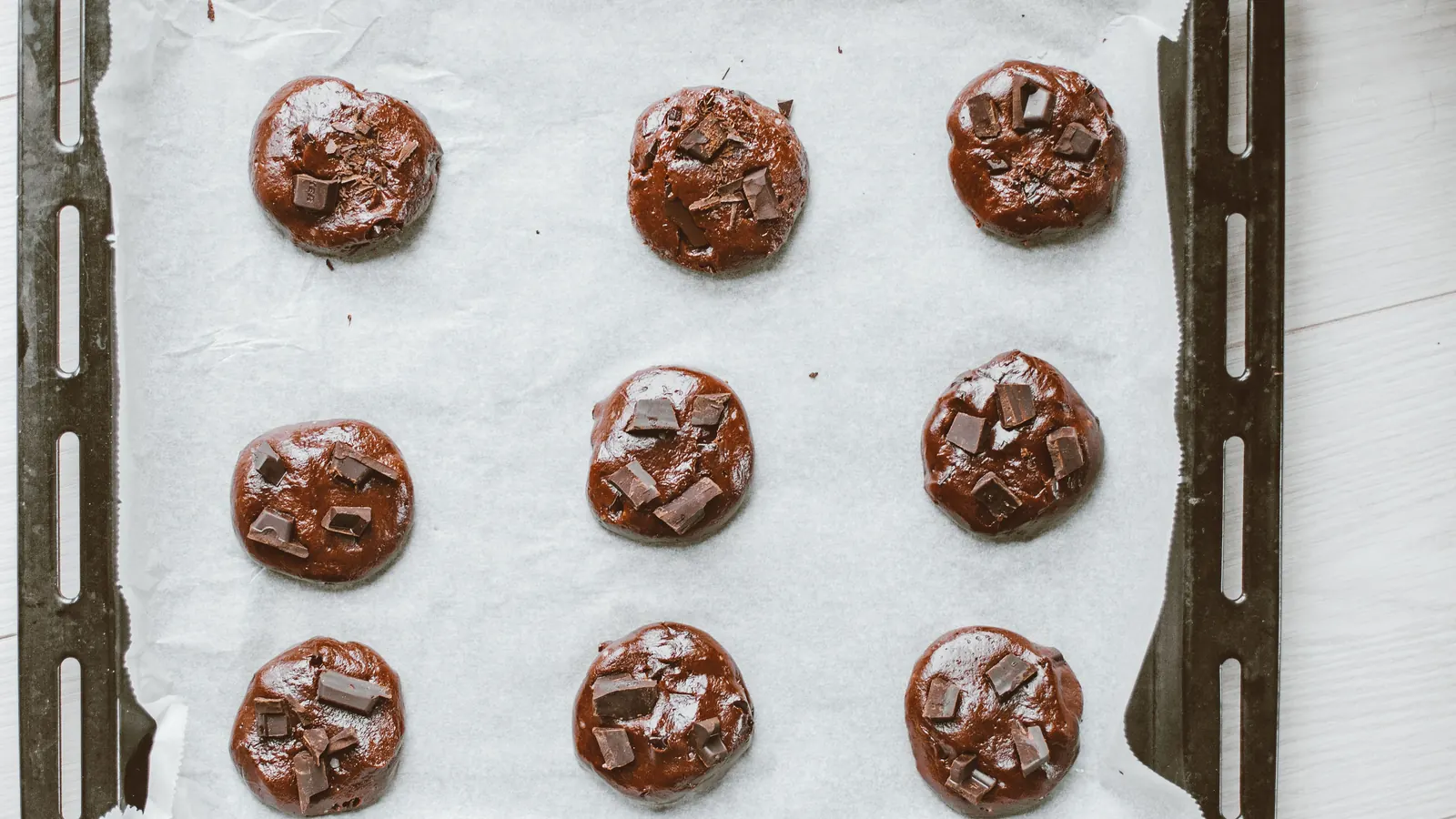
A 22 g cookie, sold in bags of 12. 22 ÷ 30 = 73%, which is between 67% and 200%, so the serving is 1 cookie (22g). The bag holds 12 × 22 = 264 g, and 264 ÷ 22 = 12 servings exactly. No "about".
An 11 g cookie, sold in tins of 20. 11 ÷ 30 = 37%, so the serving is the number of whole cookies closest to 30 g. Two cookies are 22 g (8 g short), and three are 33 g (3 g over). The serving is 3 cookies (33g). The tin holds 20 ÷ 3 = 6.67 servings, which rounds to "about 7 servings".
A 17 g cookie. 17 ÷ 30 = 57%, between 50% and 67%, so you may declare 1 cookie (17g) or 2 cookies (34g). Pick one and use it on every label for that product.
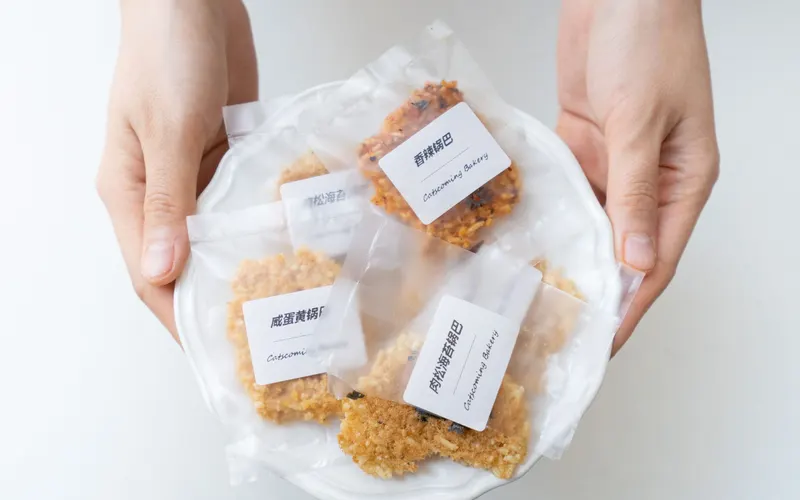
A 55 g bakery cookie, wrapped and sold on its own. 55 ÷ 30 = 183%, under 200%, so it's a single-serving container: the serving is 1 cookie, and the label shows the whole cookie. Because it is over 150%, you could add an optional second column, but you don't have to.
An 85 g cookie, wrapped and sold on its own. 85 ÷ 30 = 283%, between 200% and 300%, so it needs a dual-column label. One column is per serving, the amount closest to 30 g. A third of the cookie is 85 ÷ 3 = 28.3 g (1.7 g short), and half is 42.5 g (12.5 g over), so the serving column is for 1/3 cookie (28g). The other column is for the whole cookie.
Example: a 12-ounce bag of granola
Say the granola is packed in 340 g (12 oz) bags. To choose the cereal row, weigh a cup. The RACC could be as much as 60 g, so FDA's guidance points to measuring at least 600 g. In this example, six level cups filled without packing weigh 672 g, so a cup weighs 672 ÷ 6 = 112 g. That's well over 43 g per cup, so the RACC is 60 g.
Next, find the cup measure closest to 60 g. Cups go in 1/4- or 1/3-cup steps:
| Measure | Weight | Distance from 60 g |
|---|---|---|
| 1/3 cup | 112 ÷ 3 = 37.3 g | 22.7 g |
| 1/2 cup | 112 ÷ 2 = 56 g | 4 g |
| 2/3 cup | 112 × 2/3 = 74.7 g | 14.7 g |
The serving is 1/2 cup (56g). Servings per bag: 340 ÷ 56 = 6.07, which rounds to "about 6 servings".
A much lighter product changes the row. If a very light, unclustered mix weighed 38 g a cup, it would fall in the 20-to-43 g row, the RACC would be 40 g, and the serving would be 1 cup (38g), with 340 ÷ 38 = 8.9 servings, rounding to "about 9". Weigh every new recipe; a reformulation can move you between rows.
Example: a 5 fl oz bottle of hot sauce
The RACC table lists hot sauces under minor condiments, with a RACC of 1 tsp. The serving is 1 tsp.
A thin, pourable hot sauce is a liquid, so the metric amount is in milliliters: 1 tsp (5 mL). The RACC table offers both "1 tsp (__ g)" and "1 tsp (5 mL)" because the same category also covers mustard and horseradish, which are declared in grams.
The bottle holds 5 fl oz. For the net quantity, that's 5 × 29.57 = 147.9 mL, declared "5 fl oz (148 mL)". Servings per container: 147.9 ÷ 5 = 29.6, which rounds to "about 30 servings".
Your nutrient math still needs the teaspoon's weight. Following the 10-times rule, measure 50 mL (10 teaspoons). If it weighs 52 g in this example, a teaspoon weighs 5.2 g, and that's the figure to multiply your per-gram nutrient values by.
What mistakes make a serving size wrong?
The serving comes from the reference amount, so a smaller serving chosen to bring calories or sugar down doesn't comply. Pourable sauces, dressings and drinks declare the metric amount in milliliters, not grams. And a new bag or bottle size changes servings per container even when the serving size stays the same, so update the label with the package.
The guide to making a Nutrition Facts label without a lab covers the next part: calculating and rounding the nutrient values for the serving you've chosen.
KitchenSync is nutrition label and recipe costing software for small food businesses. Once you've settled a product's serving, you can save the serving size, servings per container and household measure as a named preset, such as "12 oz bag", and load it on any recipe; the nutrition label generator page has more. Bakers with a dozen-cookie bag and a tin of 20 can set up both once and switch between them; see KitchenSync for bakeries.
This is general information about federal labeling rules, not legal advice. Your product and your state can change the answer, so check with your state agriculture or health department, or a labeling professional, about anything you're unsure of.
Sources
- 21 CFR 101.9, Nutrition labeling of food, Electronic Code of Federal Regulations
- 21 CFR 101.12, Reference amounts customarily consumed per eating occasion, Electronic Code of Federal Regulations
- Reference Amounts Customarily Consumed: List of Products for Each Product Category: Guidance for Industry (February 2018), U.S. Food and Drug Administration
- Guidance for Industry: Guidelines for Determining Metric Equivalents of Household Measures, U.S. Food and Drug Administration
- Changes to the Nutrition Facts Label, U.S. Food and Drug Administration