Total Sugars on a Nutrition Facts label is every free sugar in the food, wherever it came from. Added Sugars is the part of that total that was added: sugar, syrups, honey, and the extra sugar in concentrated juice. It sits indented under Total Sugars as "Includes Xg Added Sugars," with a %DV based on 50 grams. Sugar alcohols such as erythritol get their own line only if you choose to show them, or if you make a sugar claim that requires it.
Where to go from here:
- If you sweeten with sugar, honey, syrup, juice concentrate or dried fruit, check which ingredients count as added sugars.
- If you need the number for a recipe, work through the cookie example. Baked and fermented products have one extra rule.
- If you jar honey or bottle maple syrup on its own, the label works differently.
- If you sweeten with erythritol, xylitol or another sugar alcohol, see when you need a sugar alcohol line.
- If you sweeten with allulose, it stays out of both sugar lines.
Total Sugars counts every sugar, natural or added
FDA's nutrition labeling rule defines total sugars as "the sum of all free mono- and disaccharides (such as glucose, fructose, lactose, and sucrose)." The lactose in milk, the fructose in raisins and the sucrose you poured in all count. Declare it to the nearest gram. Under 0.5 g per serving may be shown as zero.
If a serving has less than 1 gram and you make no claims about sweeteners, sugars or sugar alcohols, you can leave the line off. Then the label must say "Not a significant source of total sugars" at the bottom of the nutrient table. Alternatively, you can declare "less than 1 gram" or "Contains less than 1 gram."
What counts as added sugars?
The rule says added sugars "are either added during the processing of foods, or are packaged as such, and include sugars (free, mono and disaccharides), sugars from syrups and honey, and sugars from concentrated fruit or vegetable juices that are in excess of what would be expected from the same volume of 100 percent fruit or vegetable juice of the same type." It then carves out a few uses of juice concentrate. Between the rule, FDA's added sugars questions and answers and its consumer page on added sugars, common ingredients fall like this:
| Ingredient | Added sugars? |
|---|---|
| Granulated, brown or powdered sugar, dextrose | Yes |
| Honey, maple syrup, corn syrup used in a recipe | Yes |
| Juice concentrate used to sweeten | Yes, the sugar above what the same volume of 100% juice would have |
| Juice concentrate used toward a juice percentage declaration, or for the fruit in a standardized jam or jelly | No |
| Whole fruit, fruit pieces, purees, pulps | No |
| Dried fruit with nothing added | No |
| Sweetened dried fruit | The added sugar is added sugars |
| Chocolate chips, flavorings and other ingredients that contain added sugar | Yes, the added sugar portion |
| Lactose naturally in milk | No |
Sweetened dried cranberries have a narrow special arrangement. It covers dried cranberries without added flavorings, and cranberry beverages, whose total sugars per serving don't exceed those of a comparable product with no added sugars. Those products still declare added sugars in grams and as %DV, and FDA allows a "†" after the %DV pointing to a statement outside the Nutrition Facts box that explains the sugar offsets the fruit's tartness (FDA's June 2019 guidance on single-ingredient sugars and cranberry products). The arrangement applies to the cranberry product itself. A muffin or cookie that contains sweetened cranberries declares their added sugar in the usual way.
If a serving has less than 1 gram of added sugars and you make no claims about sweeteners, sugars, added sugars or sugar alcohols, the same options apply as for total sugars: leave the line off and print "Not a significant source of added sugars," or declare "less than 1 gram." Under 0.5 g may be shown as zero.
The added sugars Daily Value is 50 grams
The Daily Value for added sugars is 50 g for adults and children 4 and older. Total Sugars has no %DV.
You may calculate the percentage from the rounded number on the label or from the unrounded amount. That choice can move the result by a percentage point, as the example below shows.
Do jarred honey and maple syrup need an added sugars line?
Not in grams. If you jar honey or bottle maple syrup as a single-ingredient product, the 2018 Farm Bill means you don't have to print "Includes Xg Added Sugars." You still have to show the added sugars %DV. The same June 2019 guidance that covers cranberries allows a "†" after that %DV leading to a footnote inside the Nutrition Facts box that explains, truthfully, how much sugar a serving adds to the diet and its share of the Daily Value. It limits this to pure, single-ingredient sugars and syrups.
Once that same honey goes into a recipe, it is an ingredient, and its sugars are added sugars in the finished food.
How do I work out added sugars for a recipe?
FDA doesn't give you a formula. Its added sugars Q&A says it is up to the manufacturer to decide which ingredients supply sugars that meet the definition, and that you may need to ask suppliers how much added sugar their ingredients contain. For each ingredient, multiply its weight by its sugar content, sort the results into added and naturally occurring, add them up, and divide by the finished weight.
When a product mixes naturally occurring and added sugars, which most do, the rule requires you to make and keep records that support the added sugars number. Your formula sheet and batch weights are those records.
What if baking or fermentation uses up some of the sugar?
Baking and fermenting can use up part of the added sugar: some browns in the oven, and yeast and bacteria eat some. So the finished food can hold less added sugar than you put in. The rule allows for this when browning or fermentation reduces added sugars, and gives you two practical routes for the number you declare:
- The data route: declare the added sugars left after baking, backed by scientific data specific to your type of food and a written explanation of why it is enough.
- The records route: keep records of the added sugars you put in before and during processing and declare that amount, "and in no event shall the amount of added sugars declared exceed the amount of total sugars on the label."
The Q&A adds that if your pre-baking figure would come out higher than the total sugars found by analysis, you declare added sugars equal to that total. The records route needs no lab, and it is the one the example below uses.
Example: a batch of honey-maple oatmeal cookies
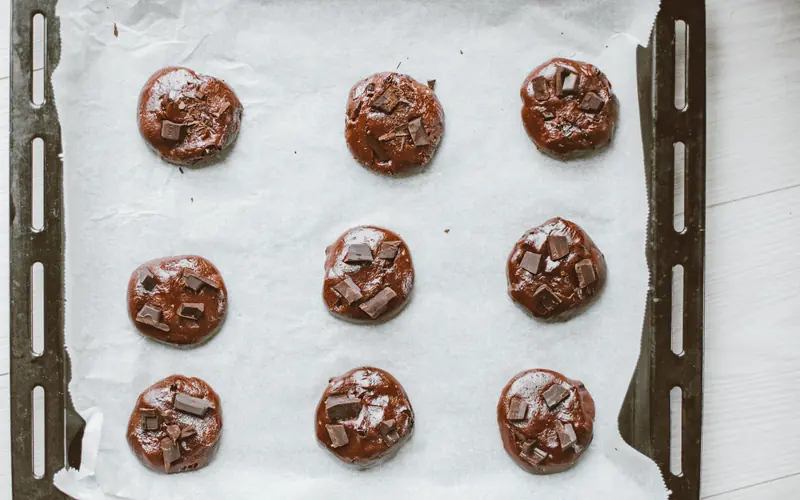
These numbers are an example, and the cookies are a dessert, picked because they use three added sweeteners and a fruit with natural sugar. The sugar values are from USDA FoodData Central (SR Legacy entries); use the values from your own entries or supplier spec sheets.
| Ingredient | Weight (g) | Sugars per 100 g | Sugars in batch (g) | Added? |
|---|---|---|---|---|
| All-purpose flour | 250 | 0.27 | 0.7 | No |
| Rolled oats | 200 | 0.99 | 2.0 | No |
| Unsalted butter | 225 | 0.06 | 0.1 | No |
| Whole egg | 100 | 0.37 | 0.4 | No |
| Raisins (dark, seedless) | 150 | 65.2 | 97.8 | No |
| Honey | 120 | 82.1 | 98.5 | Yes |
| Maple syrup | 60 | 60.5 | 36.3 | Yes |
| Brown sugar | 100 | 97.0 | 97.0 | Yes |
| Batch | 1,205 | 332.8 |
Added sugars in the batch: 98.5 + 36.3 + 97.0 = 231.8 g. Total sugars: 332.8 g.
The dough weighs 1,205 g and the baked cookies 1,060 g. Most of the lost 145 g is water, and water carries no sugar, so divide the sugar totals by the baked weight. Some sugar is also used up as the cookies brown, and the records route caps added sugars at total sugars. (Accounting for moisture loss covers baked weight in more detail.)
Each baked cookie weighs 30 g, which is also FDA's reference amount for cookies, so one cookie is one serving. The factor is 30 ÷ 1,060 = 0.0283.
- Added sugars: 231.8 × 0.0283 = 6.56 g, declared as 7 g.
- Total sugars: 332.8 × 0.0283 = 9.42 g, declared as 9 g.
- %DV from the unrounded amount: 6.56 ÷ 50 = 13.1%, shown as 13%.
- %DV from the declared amount: 7 ÷ 50 = 14%.
Both percentages are allowed. Pick one method and use it consistently.
The 7 g of added sugars is below the 9 g of total sugars, so the records-route cap doesn't come into play. If the raisins had been sweetened, their added sugar would move into the added column. That's where a supplier spec sheet matters: the USDA entry for plain raisins won't tell you what your supplier added.
KitchenSync is nutrition label and recipe costing software for small food businesses. You mark which ingredients supply added sugars, such as the honey, maple syrup and brown sugar here, and the label fills in the Added Sugars line and its %DV from the recipe. Bakers juggling several sweeteners can read how KitchenSync handles bakery labels and costing.
When do sugar alcohols need their own line?
The line is voluntary unless your label makes a claim about sugar alcohols or about total sugars, or a claim about added sugars while the food contains sugar alcohols. Any of those makes it required. A "no added sugar" cookie sweetened with erythritol needs the line.
The rules for the line:
- Call it "Sugar alcohol." If the food contains only one, you may use its name instead, such as "Erythritol" or "Xylitol."
- With two or more, use a single "Sugar alcohol" line for their combined weight.
- Indent it, and round to the nearest gram, the same as sugars.
- It has no %DV.
Sugar alcohols aren't sugars, so they don't go in Total Sugars or Added Sugars. They are carbohydrates, and they stay in Total Carbohydrate. FDA's October 2020 guidance on allulose, covered next, makes the point in passing: Total Carbohydrate is measured by difference and includes substances "that provide few or no calories, such as sugar alcohols and dietary fibers."
Allulose stays out of Total Sugars and Added Sugars
Allulose is a simple sugar (a monosaccharide, like glucose and fructose), not a sugar alcohol, so on chemistry alone it would count as sugar. In its allulose guidance, FDA says it will use enforcement discretion, meaning it won't take action against you if you:
- leave allulose out of Total Sugars and Added Sugars, and
- count it at 0.4 calories per gram when calculating Calories.
The guidance also says allulose "must be included in the amount of 'Total Carbohydrate' declared on the label." It is still listed on FDA's site as of October 2026. That promise not to enforce is a policy, not a regulation, so check FDA's guidance page again before a reprint.
Because allulose isn't a sugar alcohol, it doesn't belong on a sugar alcohol line either.
If you are still deciding whether you need a Nutrition Facts panel at all, the small business exemption is the place to start.
This is general information about federal labeling rules, not legal advice. State rules and your own product can change the answer; check with your state agriculture or health department for anything you're unsure of.
Sources
- 21 CFR 101.9, Nutrition labeling of food, eCFR
- Added Sugars on the Nutrition Facts Label, U.S. Food and Drug Administration
- Nutrition and Supplement Facts Labels: Questions and Answers Related to the Compliance Date, Added Sugars, and Declaration of Quantitative Amounts of Vitamins and Minerals: Guidance for Industry (revised December 2019), U.S. Food and Drug Administration
- FDA Issues Final Guidance Regarding the Declaration of Added Sugars on the Nutrition Facts Label for Honey, Maple Syrup, Other Single Ingredient Sugars, and Certain Cranberry Products (June 18, 2019), U.S. Food and Drug Administration
- The Declaration of Added Sugars on Honey, Maple Syrup, Other Single-Ingredient Sugars and Syrups, and Certain Cranberry Products: Guidance for Industry, U.S. Food and Drug Administration
- Guidance for Industry: The Declaration of Allulose and Calories from Allulose on Nutrition and Supplement Facts Labels, U.S. Food and Drug Administration
- The Declaration of Allulose and Calories from Allulose on Nutrition and Supplement Facts Labels (PDF, October 2020), U.S. Food and Drug Administration